Putting Text on a Path
The adjustment of letters’ and words’ positions are merely the finishing touch. More often, it is useful to start out by layouting the text as a whole in a drawing. Inkscape offers two options for this, which are accessible via and .

To make a text that follows a path’s curvature, you need to do this:
Create a path that will serve as the base line for the words and letters of the text. The path can be created by using the shape tools and combining shapes with the Boolean operations, or by drawing it directly with one of the tools that draw paths.
Write the text directly on the canvas, after clicking on it with the mouse. It’s not useful to use flowed text in a frame for this.
If you would like the text to be centered on the middle of the path, or change its alignment from left-aligned to right-aligned, or vice versa, change the text’s alignment now, before you put it on the path.
With the Selector tool, select the path and the text. Then make Inkscape do the work by selecting from the menu.
The result will show up on the canvas immediately. The text can still be edited at any time: you can change its contents or style whenever you like. The path will remain editable, too: you can shape its curves, add or delete nodes, move it, etc. and the text will automatically adjust to its changed shape.
By default, the path now represents the text’s baseline.
If you want to move the text up or down in relation to the path, you can change
the vertical kerning  of the text.
This path now serves to position the text. If you delete it, the text doesn’t have anything to follow anymore, and reverts to its previous shape. If you don’t want to see the path in your drawing, remove its fill and its stroke!
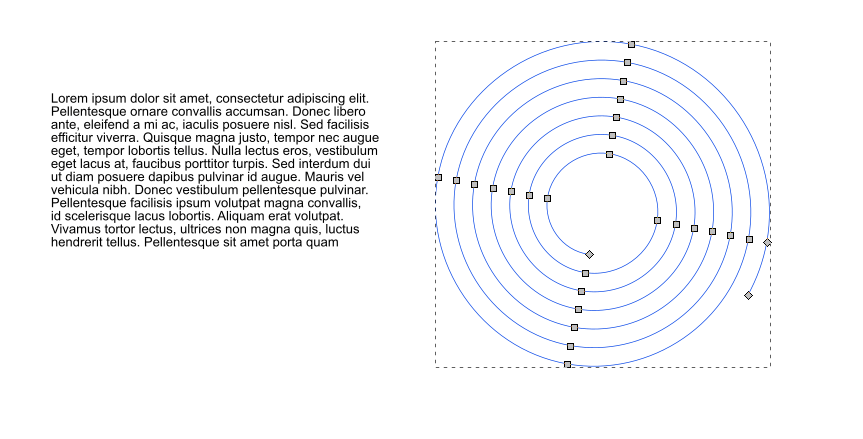
Create a text and a path by whichever method you prefer…
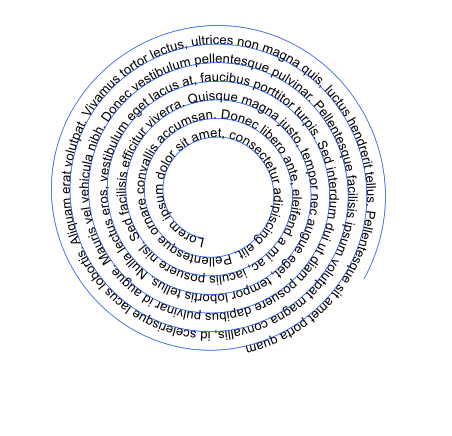
… and put the text on the path using .